64% of Young Americans Say Brand Social Posts are Starting to Blend Together
Nov. 11, 2026
Brands are struggling to stand out on social media, with nearly two-thirds (64%) of young Americans surveyed agreeing that they see so many similar-looking brand posts that they start to blend together, according to new research from global social-first agency Born Social, conducted in collaboration with market research agency The Mix Global.
The research also found that among respondents who had recently discovered something on social media, 50% found it through a creator or influencer, compared with 34% through brand-led content.
Together, the findings highlight a growing challenge for marketers: how do you build a distinctive brand when other people – and increasingly AI – shape how it's discovered, understood and recommended?
Born Social calls this the rise of the 'headless brand’: a brand whose identity is increasingly shaped by what creators, communities, search engines and AI say about it, rather than just what the brand says about itself. As consumers turn to AI to research and evaluate products, the reviews, conversations and creator content that exist beyond a brand's own channels can influence not just how it is perceived, but whether it is discovered and recommended in the first place.
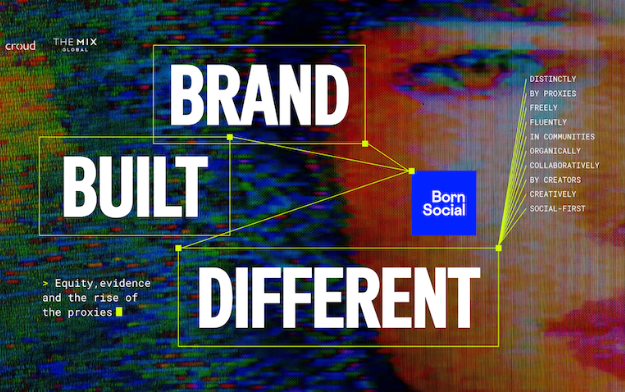
The findings appear in Brand Built Different: Equity, Evidence and the Rise of the Proxies, a new report from Born Social, the agency behind social-first work for brands including Guinness, Smirnoff, Stanley 1913 and Nikon. Based on a survey of 2,019 US adults ages 18–34 and 13 in-depth interviews with creators and consumers, it explores how people discover, assess and choose brands through creators, communities, search and AI, often without hearing directly from the brands themselves.
The research also challenges the idea that young people simply dislike advertising. Some 45% say they don't mind being sold to on social media, yet 68% prefer branded content that doesn't feel like an ad. In other words, it may be less about whether brands advertise and more about how they do it. The same tension appears in creator partnerships: 44% prefer content in the creator's own style, compared with just 11% who favor the brand's style. Another 32% prefer a balance.
Callum McCahon, Chief Strategy Officer, Croud & Born Social, said:
"Think about the last time you bought something in a category you knew nothing about. Chances are, you didn't start with the brand. You asked people, watched reviews, searched social or turned to AI for recommendations. That's increasingly how brands are being built, whether marketers like it or not. That doesn't mean the fundamentals of brand building have changed. Distinctiveness still matters enormously. But brands need to stop confusing control with consistency. The question isn't whether you can control every conversation about your brand. It's whether you've built something distinctive enough for other people to carry forward."
If brands no longer control every part of their story, Born Social argues they need to rethink how they build recognition, earn trust and ensure their brands are discoverable beyond their own channels. Its Equity × Evidence model brings together two things: the distinctiveness that makes a brand memorable, and the proof that gives people confidence to choose it.
As McCahon puts it in the report: "Equity gets you chosen. Evidence gets you over the line."
That evidence increasingly comes from outside the brand itself: creator content, reviews, community conversations and recommendations. The challenge is to build brands that travel: brands that remain recognizable across creators, communities and AI, while giving people credible reasons to choose them.
Liv Wedderburn, Head of Influence, Born Social, said:
"Putting a brand in front of a creator's audience doesn't automatically make it relevant. The real test is whether people remember the brand behind the content, and whether something distinctive about it sticks. That means moving beyond rigid briefs and perfectly controlled messaging. Brands need to give creators something recognizable to work with, but enough freedom to make it their own. Otherwise, you're just renting someone's audience rather than building something that lasts."
The report also challenges marketers to rethink how they measure the impact of social and creator marketing. Reach, views and engagement can show how far content travels, but not whether the brand travels with it.
Born Social argues that marketers need to look beyond visibility to whether people remember the brand behind the content, whether it shapes their perception, and whether it helps others discover, trust and choose it long after a campaign ends.
Tash Walker, Founder, The Mix Global, said:
"For too long, there’s been a gap between how people discover brands and how we measure what drives their influence. Today, simply understanding how consumers perceive your brand in isolation isn't enough. As influence increasingly sits beyond a brand’s own channels, marketers need to understand not just their own cultural equity, but the equity of the creators, communities and platforms consumers are turning to. Understanding those relationships is key to understanding how brands build relevance today."

Latest News

Nov. 11, 2026
H/L Celebrates Diwali With Toyota and a Music-Centered Spot Featuring Bay Area Artist Fijiana
As home to one of the largest South Asian populations in the United States and a key community for NorCal Toyota

Nov. 11, 2026
Saint Elmo's Tourism and Schwarzwald Tourismus Develop Cuckoo Clock for Kelly Clarkson
Kelly Clarkson inquired about the bird in Brooklyn and later reported on X that she had been treated condescendingly