Tech & Soul Takes a Closer Look at the Other Side of Tourism in new UNQUIET ad
Sep. 10, 2026
Traveling to discover new places, cultures, and landscapes has never been more accessible. But in a world where the same destinations are becoming increasingly crowded, one question arises: to what extent can the pursuit of the perfect experience put at risk the very things that made us want to travel in the first place?
It is from this provocation that Tech & Soul - Brazilian independent agency - has created a new ad for UNQUIET Magazine, now in its 24th edition. Built around the strategic concept “Traveling the world requires the awareness to keep it alive,” the campaign draws attention to the impacts of tourism and proposes a new way of looking at the relationship between travelers and the places they visit.
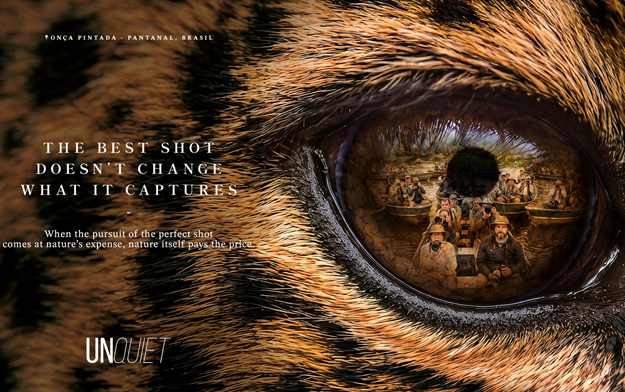
The piece features a close-up of a jaguar’s eye from Brazil’s Pantanal wetlands. Reflected in its eye is a scene of tourists searching for the perfect shot. The image captures the contradiction at the heart of the campaign: when the pursuit of the perfect picture turns nature into a backdrop, the one paying the price is precisely what we came to capture.
The idea stems from a scenario that is increasingly present in contemporary tourism: the concentration of visitors in the same destinations and the resulting pressure on ecosystems, communities, and local cultures. At the same time, travelers themselves are changing their expectations. According to the Travel & Sustainability Report 2025, 69% of travelers worldwide say they want to leave the places they visit better than they found them. The question, therefore, lies in the gap between this intention and the actual impact caused by millions of tourists around the world.
Ricardo Andrés, Creative Director at Tech & Soul, who created the campaign alongside Zim Hernandez explained:
"The idea was to provoke a reflection on the paradox of traveling to admire the world while, at the same time, contributing to the transformation of these places. It is not about giving up on discovering the world, but about thinking about how we do it and what we leave behind."
The campaign unfolds across two creative territories. The first, “What Do We Leave Behind?”, invites travelers to reflect on the marks they leave behind, from waste to environmental and cultural impacts, as well as the overexploitation of resources and the removal of elements that should remain in their places of origin.
The second, “New Destinations,” proposes a change of course. Instead of concentrating millions of people in the same postcard destinations, discovering lesser-known places and new travel possibilities can contribute to a more balanced distribution of tourist flows.
With the campaign, UNQUIET reinforces a discussion that goes beyond the destination itself. It is not enough to think about the world we want to discover; we also need to think about the world we want to find and leave behind after we are gone.
Related News
Tech & Soul has three Works Selected in the Last Issue of the Year by Lurzer's Archive
Among Brazilian agencies, Tech & Soul has the highest number of works selected in the 2025 ranking

B3 Partners with Investment Platform to Test People-Backed Betting as Healthier Gambling Alternative
B3 and Genial Investimentos team up to offer healthier alternative to online betting

Unquiet Magazine Turns Relaxing Nature Sounds into Climate Crisis Alarm
Tech & Soul's "Uncomfortable Nature Sounds" campaign hides environmental disaster sounds in calm nature playlists

Latest News

Oct. 22, 2026
Gerety Awards Celebrates Brazilian Winners at its First-Ever Winners Cocktail in Sao Paulo
The evening recognised five trophies awarded to Brazilian agencies BETC HAVAS and AMPFY

Oct. 22, 2026
AI Movie Awards Reveals 30 Finalists Ahead of London Ceremony
The finalists span categories including Best Short, Best Animation, Best Thriller, Best Sci-Fi, Best Ad, Best Music Video